

On a still October morning at The National Long Island, Course Manager Leigh Yanner orchestrated what might appear to be a simple operation: hydroseeding the 16th and 18th greens. But this was precision agronomy meeting years of accumulated knowledge, executed with the kind of attention to detail that separates world-class courses from the merely good.
The National Journal Presents
Hydroseeding Day
The precise art of hydroseeding, laying the foundation for world-class putting surfaces at Long Island.
Featuring quotes from Leigh Yanner.
Written, Filmed & Photographed by William Watt
Perfect Conditions
“Perfect morning for it,” Leigh observes as the crew assembles at first light. “Wind’s good. Moisture’s good.” These aren’t casual remarks. In the delicate process of hydroseeding, conditions aren’t just helpful; they’re crucial. The absence of wind means the seed-laden slurry will land precisely where it’s directed, not drift across bunkers or fairways. The moisture in the soil creates the ideal environment for germination.
Engineering the Foundation
Before any seed touches the ground, there’s critical preparatory work. Around the bunkers, the distinctive black sands of the Sandbelt are compacted hard to create stable edges.
“The black sand,” Leigh explains, “is what Royal Melbourne’s greens are predominantly made out of. This is how you get those sharp edges. We fluff it up just prior to seeding to help it stick to those areas, otherwise it can run off, unlike with the imported sand used on the rest of the green surface.” It’s a small detail with big implications. The wrong sand, the wrong preparation, and you’re chasing washouts and failed germination for months. Get it right, and the foundation is set for decades.

Hydroseeding Day at Long Island
The Science of Seed
Partway through the morning, conversation turns to seed selection, a topic that reveals the depth of thinking behind seemingly simple decisions.
“All our greens have been seeded with the same vintage of seed,” Leigh notes, discussing The National’s seed inventory. “So we’ve stored that here for a couple of years now. There can be slight variations in the strain from year to year, just like with grapes from a vineyard, so it’s important for future maintenance that all the seeds are genetically consistent across every hole.”
On seeding rates, Leigh articulates a philosophy: “I like to seed at a slightly higher rate. I think that gives you a denser, finer grass. Other people seed lower and think that results in a more robust grass. Royal Sydney for example uses a lower seed rate because of the humidity up there. Everything grows like crazy in Sydney.” It’s a reminder that informed decisions based on local conditions rely on hard-won experience.
Choreographed Precision
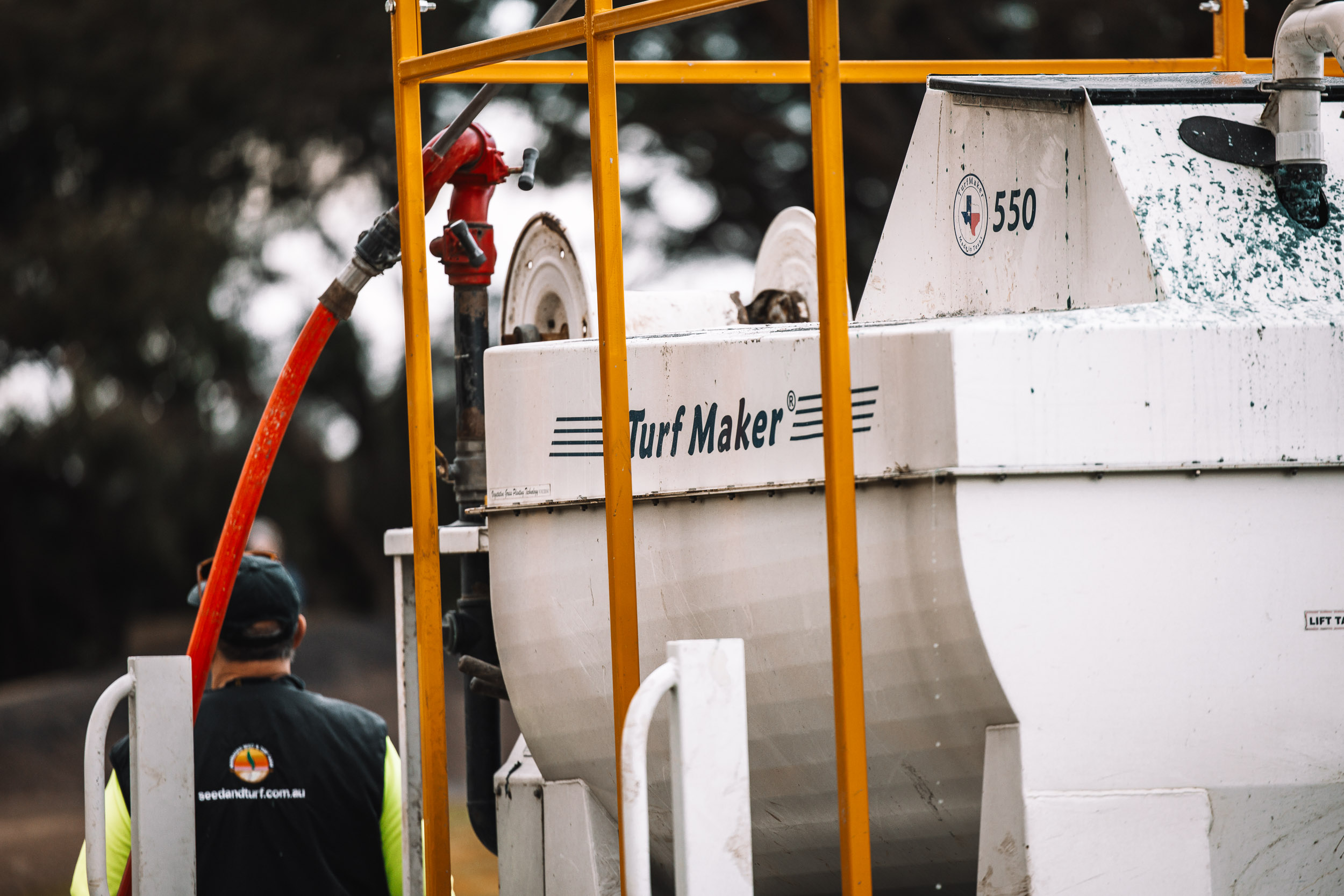
Throughout the morning, Leigh maintains constant communication with the hydroseeding operator, adjusting coverage in real-time:
“Just walk straight up and get that edge a little bit more…”
“Come in another metre on that edge…”
“Just give that a little extra juice…”
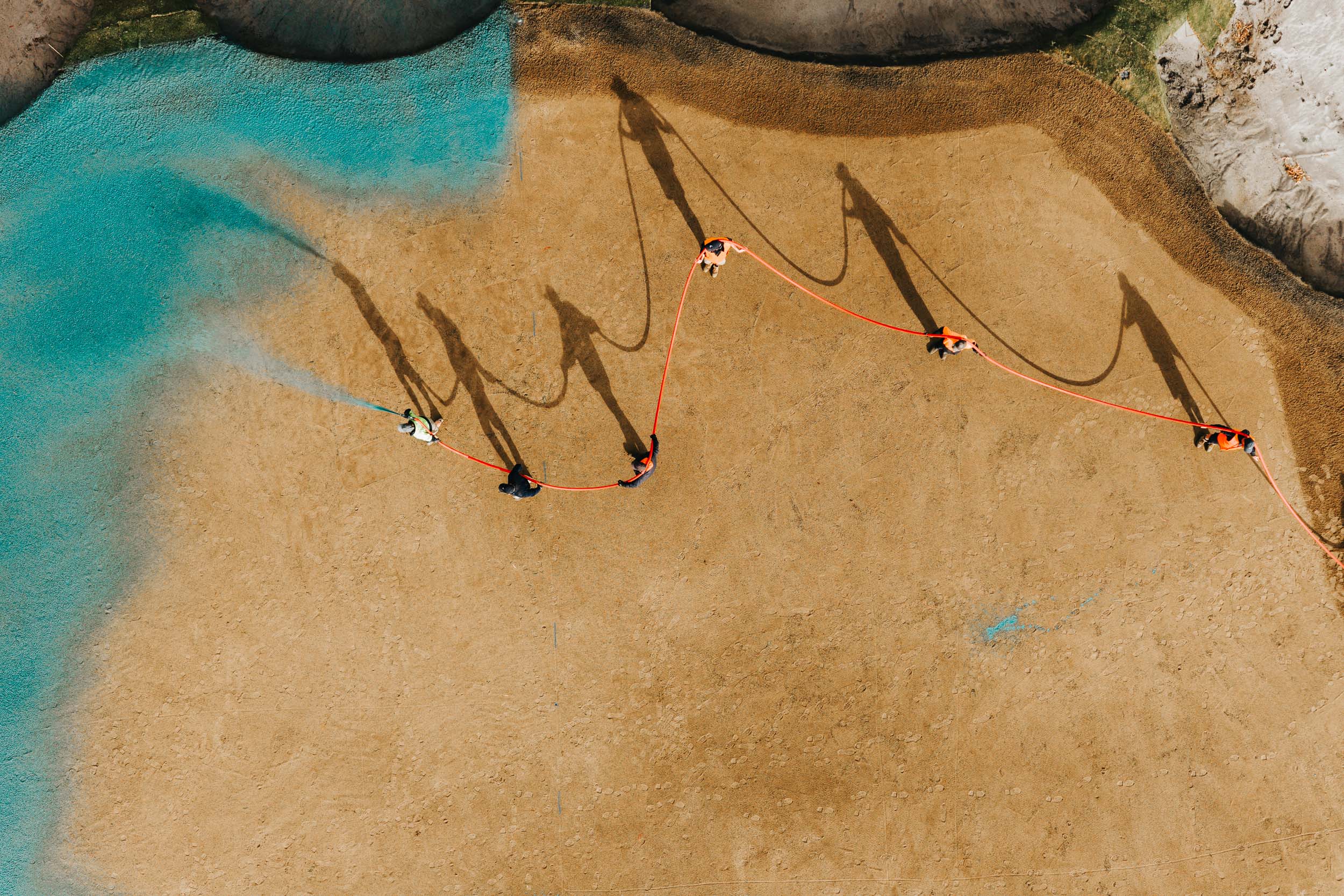
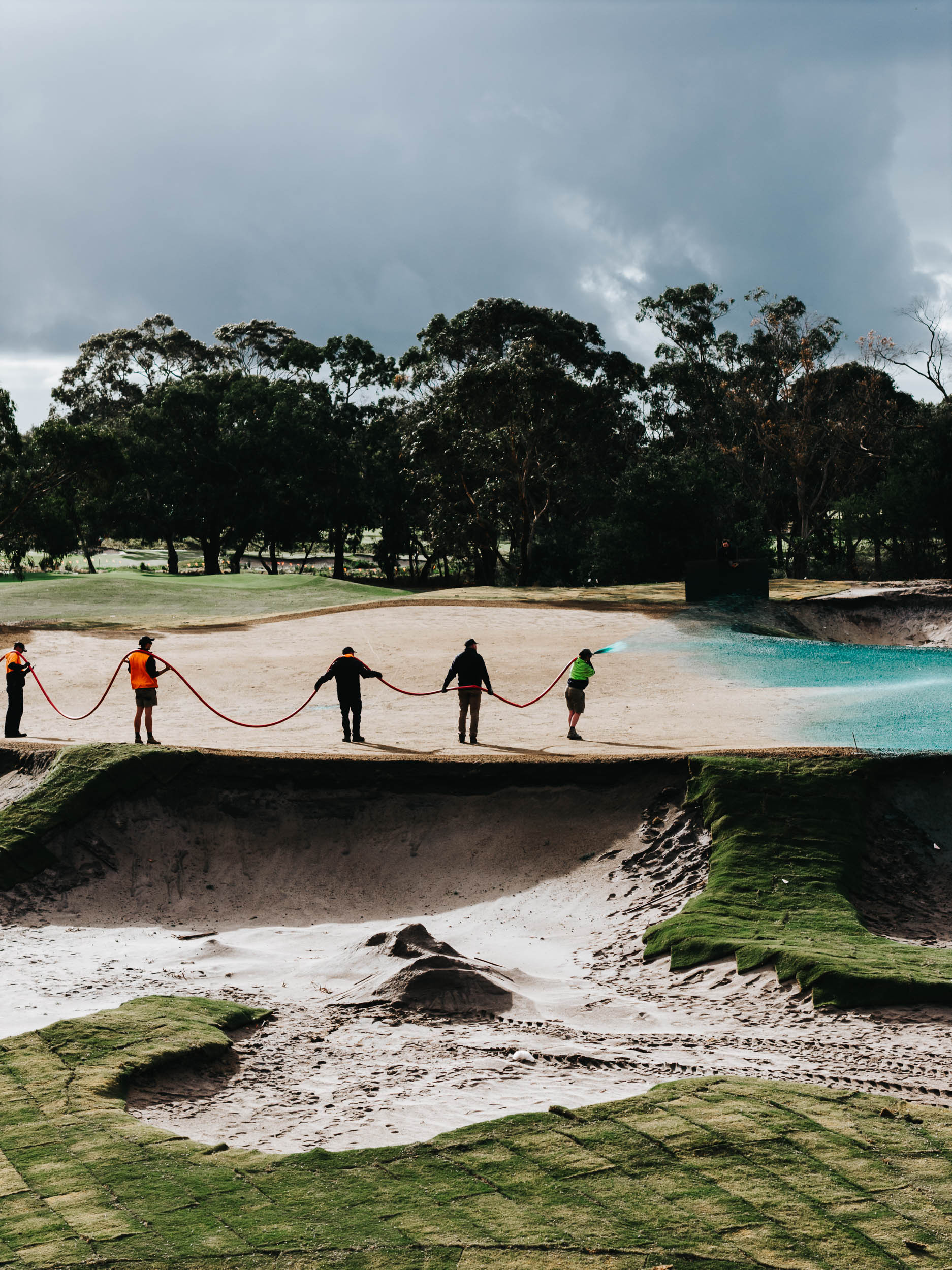
Leigh is constantly visualising how the seed will establish, where the irrigation will hit, and how the contours will affect growth patterns. The crew works methodically through designated zones. “We’ll do 300 square metres at the back here first, then we’ll go up the high side, then this last bit here,” Leigh outlines the strategy. “We’re under 400 square metres on each green, but it’s easier because of the slope. Though there’s also a lot of bunkers, so you lose a lot more around the bunkers as well.”
Calibrated Application
The process itself is mesmerising to watch: a thick blue slurry arcing through the still morning air, landing precisely where directed, coating the prepared surface. There are millions of tiny Pure Distinction bent grass seeds in the tank, suspended in a carrier of mulch, fertiliser, and binding agents.
The machine repositions, the operator adjusts pressure and angle, and slowly the bare earth transforms into a uniform blue carpet, soon to be green as the turf rapidly grows. In the weeks ahead, those millions of seeds will germinate, establish, and begin their journey toward becoming the pure putting surfaces golfers will enjoy.
Looking Ahead
As the morning’s work concludes, there’s a satisfied efficiency to the crew’s movements. The 16th and 18th are complete, well-rehearsed for “the big baby”, a reference to the massive Himalayas putting green project on the horizon.
“Big storm’s supposed to come in Sunday,” someone mentions.
“Hopefully there’ll be a big umbrella over us,” Leigh replies, equal parts hope and the realist’s acceptance that nature, as always, will have the final say.
But the foundation has been laid. The science, the experience, and the attention to detail that characterise The National’s approach to course maintenance have been applied. In just a handful of months, golfers will be putting across these surfaces as The National Long Island starts to welcome members back to the full 18 holes, and three routings, that the groundstaff and OCM Golf have worked so hard to create.
